Hi Everybody!!
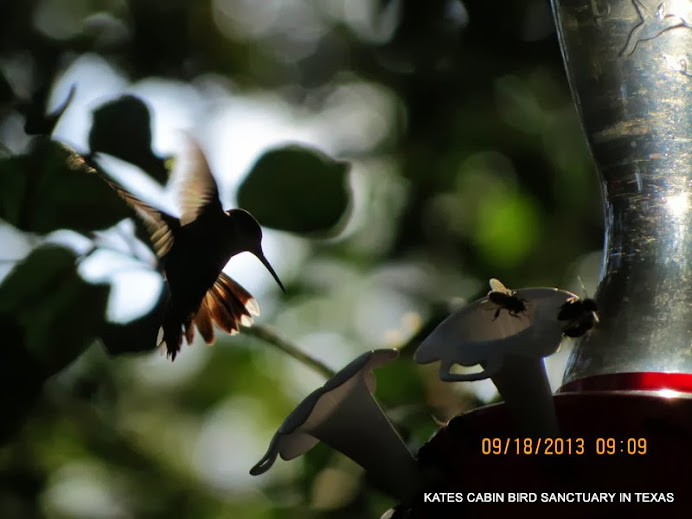
One great thing about yucky, cold February Days is staying inside where it is warm and planning the spring planting of your flowerbeds. This year we know the Monarch Butterflies are in steep decline along with the honeybees and other pollinators including the hummingbirds. Every human on Earth needs to take responsibility for increasing the beneficial pollinators around the globe. We can stop the use of herbicides and pesticides that are killing the pollinators. Most of all, we can grow more flowers everywhere! Use your cold days to do some planning for flowers to promote the growth of insects and birds. I have shared an excerpt from Wikipedia on pollination. For your photostudy, I went back to September of last year and pulled out some of the hummingbirds. Enjoy!
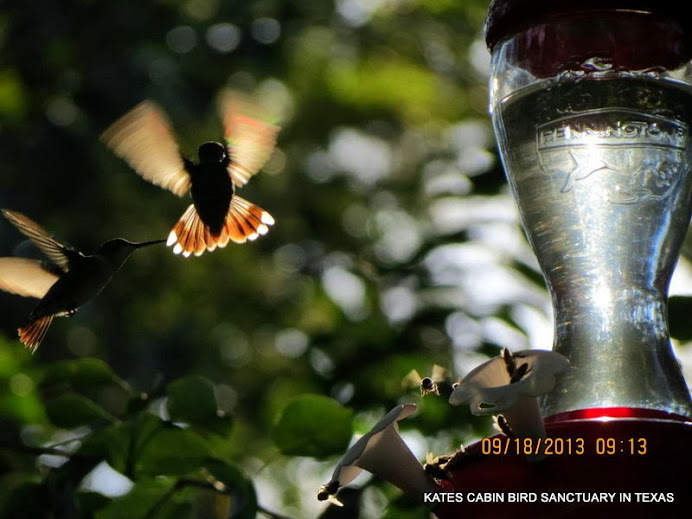


link to photostudy in G+Albums:
https://plus.google.com/photos/117645114459863049265/albums/5931106345737627617


This shows the location of the sun angle from the feeder to get the wings to light up.


There is a new movement to get farmers to grow wildflowers in with crops to attract more beneficial pollinators. Read more about this at the following link:
http://e360.yale.edu/feature/growing_insects_farmers_can_help_to_bring_back_pollinators/2735/

https://en.wikipedia.org/wiki/Pollination
Pollination
From Wikipedia, the free encyclopedia
Pollination is the process by which pollen is transferred in the reproduction of plants, thereby enabling fertilization and reproduction.
In spite of a common perception that pollen grains are gametes, like the sperm cells of animals, this is incorrect; pollination is a phase in the alternation of generations. Each pollen grain is a male haploid plant, a gametophyte, adapted to being transported to the female gametophyte, where it can achieve fertilization by producing the male gamete (or gametes, in the process of double fertilization).
As such the Angiosperm successful pollen grain (gametophyte) containing the malegametes (sperm) gets transported to the stigma, where it germinates and its pollen tube grows down the style to the ovary. Its two gametes travel down the tube to where the gametophyte(s) containing the female gametes are held within the carpel. One nucleus fuses with the polar bodies to produce the endosperm tissues, and the other with the ovum to produce the embryo[1][2] Hence the term: "double fertilization".
In gymnosperms the ovule is not contained in a carpel, but exposed on the surface of a dedicated support organ such as the scale of a cone, so that the penetration of carpel tissue is unnecessary. Details of the process vary according to the division of Gymnosperms in question.
The receptive part of the carpel is called a stigma in the flowers of angiosperms. The receptive part of the gymnosperm ovule is called the micropyle. Pollination is a necessary step in the reproduction of flowering plants, resulting in the production of offspring that are genetically diverse.
The study of pollination brings together many disciplines, such as botany, horticulture,entomology, and ecology. The pollination process as an interaction between flower andvector was first addressed in the 18th century by Christian Konrad Sprengel. It is important in horticulture and agriculture, because fruiting is dependent on fertilisation, which is the result of pollination. The study of pollination by insects is known as anthecology.
Biotic[edit]

Main article: Pollinator
More commonly, the process of pollination requires pollinators: organisms that carry or move the pollen grains from the anther to the receptive part of the carpel or pistil. This is biotic pollination. The various flower traits (and combinations thereof) that differentially attract one type of pollinator or another are known as pollination syndromes. Roughly 200,000 varieties of animal pollinators are in the wild, most of which are insects.
Entomophily, pollination by insects, often occurs on plants that have developed colored petals and a strong scent to attract insects such as, bees, wasps and occasionally ants (Hymenoptera), beetles (Coleoptera), moths and butterflies (Lepidoptera), and flies (Diptera). The existence of insect pollination dates back to the dinosaur era.
In zoophily, pollination is performed by vertebrates such as birds and bats, particularly, hummingbirds, sunbirds, spiderhunters,honeyeaters, and fruit bats. Plants adapted to using bats or moths as pollinators typically have white petals and a strong scent, whereas plants that use birds as pollinators tend to develop red petals and rarely develop a scent (few birds rely on a sense of smell to find plant-based food).
Anthropophily pollination by humans, often artificial pollination used in hybridization techniques.
Insect pollinators such as honeybees (Apis mellifera),[3] bumblebees (Bombus terrestris),[4][5] and butterflies (Thymelicus flavus)[6]have been observed to engage in flower constancy, which means they are more likely to transfer pollen to other conspecific plants.[7][8] This can be beneficial for the pollinators, as flower constancy prevents the loss of pollen during interspecific flights and pollinators from clogging stigmas with pollen of other flower species. It also improves the probability that the pollinator will find productive flowers easily accessible and recognisable by familiar clues.[9]
Mechanics[edit]
Pollination can be accomplished by cross-pollination or by self-pollination :
- Cross-pollination, also called allogamy, occurs only when pollen is delivered to a flower from a different plant. Plants adapted to outcross or cross-pollinate often have taller stamens than carpels or use other mechanisms to better ensure the spread of pollen to other plants' flowers.


- Self-pollination occurs when pollen from one flower pollinates the same flower or other flowers of the same individual.[10] It is thought to have evolved under conditions when pollinators were not reliable vectors for pollen transport, and is most often seen in short-lived annual species and plants that colonize new locations.[11] Self-pollination may includeautogamy, where pollen moves to the female part of the same flower; orgeitonogamy, when pollen is transferred to another flower on the same plant. Plants adapted to self-fertilize often have similar stamen and carpel lengths. Plants that can pollinate themselves and produce viable offspring are called self-fertile. Plants that cannot fertilize themselves are called self-sterile, a condition which mandates cross pollination for the production of offspring.
- Cleistogamy: is self-pollination that occurs before the flower opens. The pollen is released from the anther within the flower or the pollen on the anther grows a tube down the style to the ovules. It is a type of sexual breeding, in contrast to asexual systems such as apomixis. Some cleistogamous flowers never open, in contrast to chasmogamous flowers that open and are then pollinated. Cleistogamous flowers by necessity are self-compatible or self-fertile plants.[12] Many plants are self-incompatible, and these two conditions are end points on a continuum.


Pollination also requires consideration of pollenizers. The terms "pollinator" and "pollenizer" are often confused: a pollinator is the agent that moves the pollen, whether it be bees, flies, bats, moths, or birds; a pollenizer is the plant that serves as the pollen source for other plants. Some plants are self-fertile or self-compatible and can pollinate themselves (e.g., they act as their own pollenizer). Other plants have chemical or physical barriers to self-pollination.
In agriculture and horticulture pollination management, a good pollenizer is a plant that provides compatible, viable and plentiful pollen and blooms at the same time as the plant that is to be pollinated or has pollen that can be stored and used when needed to pollinate the desired flowers. Hybridization is effective pollination between flowers of differentspecies, or between different breeding lines or populations. see also Heterosis.
Peaches are considered self-fertile because a commercial crop can be produced without cross-pollination, though cross-pollination usually gives a better crop. Apples are considered self-incompatible, because a commercial crop must be cross-pollinated. Many commercial fruit tree varieties are grafted clones, genetically identical. An orchard block of apples of one variety is genetically a single plant. Many growers now consider this a mistake. One means of correcting this mistake is to graft a limb of an appropriate pollenizer (generally a variety of crabapple) every six trees or so.[citation needed]

Pollen vectors[edit]
Biotic pollen vectors are animals, usually insects, but also reptiles, birds, mammals, and sundry others, that routinely transport pollen and play a role in pollination. This is usually as a result of their activities when visiting plants for feeding, breeding or shelter. The pollen adheres to the vector's body parts such as face, legs, mouthparts, hair, feathers, and moist spots; depending on the particular vector. Such transport is vital to the pollination of many plant species.
Any kind of animal that often visits or encounters flowers is likely to be a pollen vector to some extent. For example, a crab spider that stops at one flower for a time and then moves on, might carry pollen incidentally, but most pollen vectors of significant interest are those that routinely visit the flowers for some functional activity. They might feed on pollen, or plant organs, or on plant secretions such as nectar, and carry out acts of pollination on the way. Many plants bear flowers that favour certain types of pollinator over all others. This need not always be an effective strategy, because some flowers that are of such a shape that they favour pollinators that pass by their anthers and stigmata on the way to the nectar, may get robbed by ants that are small enough to bypass the normal channels, or by short-tongued bees that bite through the bases of deep corolla tubes to extract nectar at the end opposite to the anthers and stigma. However, in general, plants that rely on pollen vectors tend to be adapted to their particular type of vector, for example day-pollinated species tend to be brightly coloured, but if they are pollinated largely by birds or specialist mammals, they tend to be larger and have larger nectar rewards than species that are strictly insect-pollinated. They also tend to spread their rewards over longer periods, having long flowering seasons; their specialist pollinators would be likely to starve if the pollination season were too short.[13]
As for the types of pollinators, reptile pollinators are known, but they form a minority in most ecological situations. They are most frequent and most ecologically significant in island systems, where insect and sometimes also bird populations may be unstable and less species-rich. Adaptation to a lack of animal food and of predation pressure, might therefore favour reptiles becoming more herbivorous and more inclined to feed on pollen and nectar.[14] Most species of lizards in the families that seem to be significant in pollination seem to carry pollen only incidentally, especially the larger species such as Varanidae and Iguanidae, but especially several species of the Gekkonidae are active pollinators, and so is at least one species of the Lacertidae, Podarcis lilfordi, which pollinates various species, but in particular is the major pollinator of Euphorbia dendroides on various Mediterranean islands.[15]
Mammals are not generally thought of as pollinators, but some rodents, bats and marsupials are significant pollinators and some even specialise in such activities. In South Africa certain species of Protea (in particular Protea humiflora, P. amplexicaulis, P. subulifolia, P. decurrens and P. cordata) are adapted to pollination by rodents (particularly Cape Spiny Mouse, Acomys subspinosus)[16] and elephant shrews (Elephantulus species).[17] The flowers are borne near the ground, are yeasty smelling, not colourful, and sunbirds reject the nectar with its high xylose content. The mice apparently can digest the xylose and they eat large quantities of the pollen.[18] In Australia pollination by flying, gliding and earthbound mammals has been demonstrated.[19]
Examples of pollen vectors include many species of wasps, that transport pollen of many plant species, being potential or even efficient pollinators.[20]




...this is brendasue signing off from Rainbow Creek. See You next time!
Link to my G+ Photo Album Gallery with all the hummingbird migration albums:
https://plus.google.com/photos/117645114459863049265/albums

O+O