Hi Everybody!!

Hi Everybody!!
Welcome to my Hometown!!
Showing posts with label red bellied woodpecker. Show all posts

Sunday, April 13, 2014

BIRD IN THE HOLE (AND OTHER SPRINGY THINGYS PHOTO BLOG)


Hi Everybody!!
Boo! It is the red-bellied woodpecker sticking his head out of the tree hole nest. This bird is easy to find by hearing him before seeing him. Once you know his signature sound, just follow the noise. He seems to enjoy making the noise in front of the hole as it throws the sound. Once you have birds coming to your feeder, I suggest you begin with a chair a distance away from the feeders and move it closer daily. The birds will adapt to you sitting there while they eat. Begin to use your camera and take many pics. This will let them get used to the camera. Soon, they will begin to show off for you! The birds who choose to come to your feeder, will already be comfortable with humans around. They are very smart and are watching you long before you see them! Below are more Springy Thingys. Enjoy!


Photo


Photo

https://plus.google.com/u/0/photos/117645114459863049265/albums/6000470848097611249


https://en.wikipedia.org/wiki/Red-bellied_Woodpecker

Red-bellied Woodpecker

From Wikipedia, the free encyclopedia
The Red-bellied Woodpecker (Melanerpes carolinus) is a medium-sizedwoodpecker of the Picidae family. It breeds in southern Canada and thenortheastern United States, ranging as far south as Florida and as far west asTexas. Its common name is somewhat misleading, as the most prominent red part of its plumage is on the head; the Red-headed Woodpecker, however, is anotherspecies that is a rather close relative but looks quite different.
Red-bellied Woodpecker
Adult male
Conservation status
Scientific classification
Kingdom:Animalia
Phylum:Chordata
Class:Aves
Subclass:Neornithes
Infraclass:Neognathae
Superorder:Neoaves
Order:Piciformes
Suborder:Pici
Family:Picidae
Subfamily:Picinae
Tribe:Dendropicini
Genus:Melanerpes
Species:M. carolinus
Binomial name
Melanerpes carolinus
(Linnaeus, 1758)
Range of M. carolinus

Description[edit]


Adult female – showing reddish belly.
Adults are mainly light gray on the face and underparts; they have black and white barred patterns on their back, wings and tail. Adult males have a red cap going from the bill to the nape; females have a red patch on the nape and another above the bill. The reddish tinge on the belly that gives the bird its name is difficult to see in field identification. They are 22.85 to 26.7 cm (9.00 to 10.51 in) long, and have a wingspan of 38 to 46 cm (15 to 18 in).[3]

Vocalizations[edit]

Red-bellied woodpeckers are noisy birds, and have many varied calls. Calls have been described as sounding like churr-churr-churr or thrraa-thrraa-thrraa with an alternating br-r-r-r-t sound. Males tend to call and drum more frequently than females, but both sexes call. Often, these woodpeckers "drum" to attract mates. They tap on aluminum roofs, metal guttering, hollow trees and even transformer boxes, in urban environments, to communicate with potential partners. Babies have a high-pitched begging call of pree-pree-pree. They will continue to give a begging call whenever they see their parents for a while after fledging.
These birds mainly search out arthropods on tree trunks. They may also catchinsects in flight. They are omnivores, eating insects, fruits, nuts and seeds. Their breeding habitat is usually deciduous forests. They nest in the decayed cavities of dead trees, old stumps, or in live trees that have softer wood such as elms,maples, or willows; both sexes assist in digging nesting cavities. Areas around nest sites are marked with drilling holes to warn others away.
Though the species is not globally threatened, it depends on large trees for nesting. In areas that are extensively deforested, the birds will sometimes utilizegardens, but for the most part simply will not be present in any numbers.[4]

Peeking out of its nest

A female Red-bellied Woodpecker feeding her chick

Foraging[edit]

As with all animals, foraging becomes an important role in an animal’s ability to survive and reproduce. The Red-bellied Woodpecker expresses foraging behavior by catching or storing food.[5]The woodpecker uses its bill for foraging as a chisel drilling into bark or probing cracks on trunk of trees.[5] In this manner, the Red-bellied Woodpecker is able to pull out beetles and other insects from the tree with the help of its long tongue.[5] This behavior is also seen for storing food from other animals by hiding food behind bark or deep in cracks of a tree.[5] According to studies from Williams 1975, Breitwisch 1977, and Batzil 1979, the Red-bellied Woodpecker spent 20% to 69% foraging on dead or decaying trees. In addition, Williams 1975, Breitwisch 1977, and Batzil 1979 observed Red-bellied Woodpecker 80% gleaning and probing and 10% excavating on trees in South Florida pine habitat.[6] The Red-bellied Woodpecker relies on snags or dying trees for foraging and nesting.[7]

Red-Bellied Woodpecker foraging behavior

Predation[edit]

Predators of adult Red-bellied Woodpeckers include birds of prey such asSharp-shinned hawks and Cooper's hawks, black rat snakes and house cats. Known predators of nestlings and eggs include Red-headed Woodpeckers,owls, Pileated Woodpeckers, gray rat snakes and black rat snakes. When approached by a predator, Red-bellied Woodpeckers either hide from the predator, or harass it with alarm calls. They defend their nests and young aggressively, and may directly attack predators that come near the nest.

Breeding[edit]

In early May, the Red-bellied Woodpeckers begin breeding activities by drumming patterns; such as, slow taps followed by short rapid drumming.[8]Woodpeckers depend on dead and drying wood for nesting purposes. The male Red-bellied Woodpecker takes the initiative in locating a nest hole. He will then seek approval from his female mate by mutual tapping.[9] The Red-bellied Woodpecker excavates holes in trees for nesting and roosting.[10] By excavating cavities, they play an important role in the forest communities for other species as well.[7] For example, species such as squirrels and bats use these cavities as shelter.[10] The female Red-bellied Woodpecker accepts the nesting hole by completing the excavation and entering the nest hole.
Researchers have documented that Red-bellied Woodpeckers have the tendency to nest in clear areas with only few trees.[10] Studies have indicated that close canopy areas does not impact the bird’s nesting behavior; however, further studies are needed and are in progress.[10] Red-bellied Woodpeckers are territorial during the nesting season and they breed once per year. A pair-breeding woodpecker begins nesting in April or May holding a year-round territories and showing high site fidelity.[11]
Red-bellied Woodpeckers depend on dead trees for nesting.[12] Recent studies have shown that these woodpeckers experienced low breeding due to cutting sites of dead trees; however, predators are still of main concern.[12][13] The juvenile Red-bellied Woodpecker are ready to fledge its nest at 24 to 26 days of age. Natal dispersal has been observed on juvenile Red-bellied Woodpeckers.[11] The juvenile Red-bellied Woodpecker remains approximately 27 weeks in its natal area after fledging.[11] In some cases, the woodpecker may return to its natal area for breeding depending on predation levels and food resources.[11]

Courtship[edit]

It has been noted that vocal signals in Red-bellied Woodpeckers is used to attract and communicate with potential mates.[9] A low “grr, grr” sound is observed in a pair of woodpeckers from the start of courtship until the end of the breeding season.[9] In an intraspecific conflict, the Red-bellied Woodpeckers usually make a loud “chee-wuck, chee-wuck, chee-wuck” sound. As indicated by Kilham 1983, the Red-bellied Woodpecker drums with its bill during conflict situation and taps to maintain pair bonding. An example of a conflict event between Red-bellied Woodpeckers would be competing for the same mate. Nevertheless, the Red-bellied Woodpeckers are known to be in monogamous relationships.


The following flowers make Berries!!

  1. How to Grow Brazos Blackberries | eHow

    www.ehow.com › Home & Garden

    How to Grow Brazos Blackberries. Brazos blackberries are a variety of fruit developed by plant breeders at Texas A&M in 1959. As a highly adaptable fruit, it has ...


The new plums!

https://en.wikipedia.org/wiki/Prunus_mexicana

Prunus mexicana, commonly known as the Mexican Plum,[2] is a species ofplum tree that is found in the Midwestern and Southeastern United States as well as Northern Mexico. Its native range stretches from South Dakota and Ohio in the north to as far south as Alabama and Coahuila.[2] Mexican Plum is widely cultivated, such as on the west coast of the United States. It has a single trunk and reaches a height of 15–38 feet (4.6–11.6 m).[4]
Typically found on woodland edges or in open fields, the Mexican Plum has dark green, simple ovate leaves, fragrant white to whitish pink flowers, and dark grey bark banded with horizontal lenticels. Mexican Plums are adaptable to a wide range of soil pH and are drought-tolerant. They are hardy in USDA zones 7 to 9.[5] Early in the spring it is covered with clouds of white fragrant flowers that are up to an inch wide. The dark red or purple fruit ripens late in the fall.[6]
Prunus mexicana
Scientific classification
Kingdom:Plantae
(unranked):Angiosperms
(unranked):Eudicots
(unranked):Rosids
Order:Rosales
Family:Rosaceae
Genus:Prunus
Subgenus:Prunus
Section:Prunocerasus[1]
Species:P. mexicana
Binomial name
Prunus mexicana
S.Watson[2]
Natural range of Prunus mexicana


The Memory Garden


...this is brendasue (and Fat Sissy) signing off from Rainbow Creek.  See You next time!


O+O

Thursday, February 27, 2014

YESTERDAY, HOT SPRING; TODAY, COLD SPRING! (FULL OF SURPRISES PHOTO BLOG)


Hi Everybody!!
As you know, my winter birds left last week on Migration to the North. They probably flew a couple of days then landed to eat and refresh before continuing the journey. At the same time, birds further south than me also headed North. I am the stop off, eat and refresh location for this flock of birds coming in now. I call these the 'Berry Birds', as they swoop down and eat the remaining berries on the trees. There is one berry bird I really prize and that is the Cedar Waxwing. They love the cherry laurel berries the most, then the hollies. Another large flock of robins came in also. They like the cherry laurels  and the new things they find in the grasses. More doves came in and they will be staying and raising the young here. Also more red bellied woodpeckers, who will also stay for spring and nest in trees. Your links are below to my G+ Photo Albums. Enjoy!


Link to G+ Photo Album:
https://plus.google.com/u/0/photos/117645114459863049265/albums/5983673644778844369

Cedar Waxwing

From Wikipedia, the free encyclopedia
https://en.wikipedia.org/wiki/Cedar_Waxwing
The Cedar Waxwing (Bombycilla cedrorum) is a member of the family Bombycillidaeor waxwing family of passerine birds. It is a medium sized, mostly brown, gray, and yellow bird named for its wax-like wing tips. It is a native of North and Central America, breeding in open wooded areas in southern Canada and wintering in the southern half of the United States, Central America, and the far northwest of South America. Its diet includes cedar cones, fruit, and insects.[2] The Cedar Waxwing is not endangered.
Cedar Waxwing
Conservation status
Scientific classification
Kingdom:Animalia
Phylum:Chordata
Class:Aves
Order:Passeriformes
Family:Bombycillidae
Genus:Bombycilla
Species:B. cedrorum
Binomial name
Bombycilla cedrorum
Vieillot, 1808
Cedar Waxwing range     Breeding range     Year-round range     Wintering range

Distribution and Habitat[edit]


In the branches of a Weeping Holly tree
Preferred habitat consists of trees at the edge of wooded areas, or "open" forests, especially those that provide access to berry sources as well as water. They are frequently seen in fruiting trees.[3] Waxwings are attracted to the sound of running water, and love to bathe in and drink from shallow creeks. In urban or suburban environments, waxwings often favor parkland with well-spaced trees; golf courses, cemeteries, or other landscaping with well-spaced trees; bushes that provide berries; and a nearby water source such as a fountain or birdbath. Also look for them near farms, orchards, and gardens, particularly ones with fruiting trees or shrubs.[3]
Outside the breeding season, Cedar Waxwings often feed in large flocks numbering hundreds of birds. This species is nomadic and irruptive,[7] with erratic winter movements, though most of the population migrates farther south into the United States and beyond, sometimes reaching as far as northern South America. They will move in huge numbers if berry supplies are low. Rare vagrants have reached western Europe, and there are two recorded occurrences of Cedar Waxwing sightings in Great Britain. Individual Bohemian Waxwings will occasionally join large winter flocks of Cedar Waxwings.
In winter, these birds can be very confident and will come into gardens for berry bushes and trees and to drink from fountains or bird baths.

Behavior and Ecology[edit]

Cedar Waxwings are sociable, seen in flocks year round.[3] They are non-territorial birds and "will often groom each other."[5] They move from place to place depending on where they can find good sources of berries.[5]


  1. Planting a Savannah Holly Tree - Ask.com

    www.ask.com/explore/planting-savannah-holly-tree

    Mar 9, 2011 - Savannah holly trees, or Ilex S attenuata 'Savannah,' are native to North America and are best planted in USDA hardiness zones six through ...


Link to G+ Photo Album:
https://plus.google.com/u/0/photos/117645114459863049265/albums/5984783502965682753


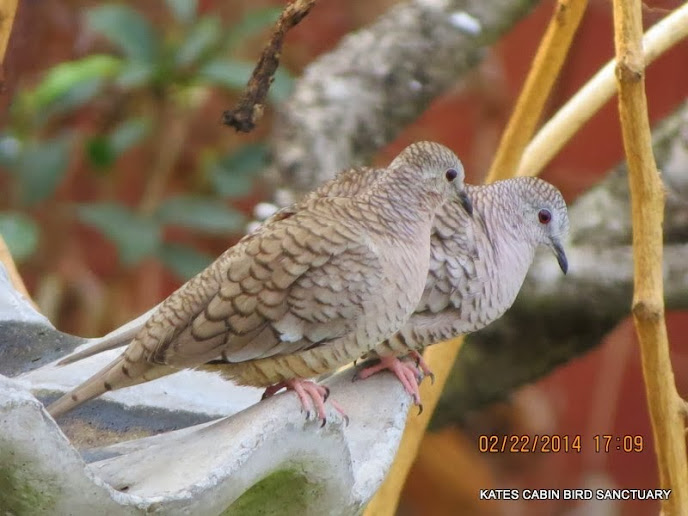
The Love Doves!


Inca Dove

From Wikipedia, the free encyclopedia
https://en.wikipedia.org/wiki/Inca_Dove
The Inca Dove (Columbina inca) is a small New World dove; it might belong to thegenus. It ranges from the southwestern United States and Mexico through Central America to Costa Rica; the Inca Dove only lives on the Pacific side of Central America. Despite being named after the Inca Empire, this species does not occur in any of the lands that constituted that region. Inca Doves are common to abundant within their range and they are expanding their range north and south.
Inca Doves reach a length of 16.5–23 cm (6.5–9.1 in) and weigh 30–58 g (1.1–2.0 oz).[2] They are slender, with a gray-brown body covered in feathers that resemble a scaled pattern. The tail is long and square, edged with white feathers that may flare out in flight. In flight, the underwing is reddish, like other ground doves, and on takeoff, the wings produce a distinctive, quiet rattling noise.
This is a terrestrial species which occurs in flocks in open areas including scrub and cultivation. It will feed in urban areas, eating grass seeds and taking advantage of the ready availability of water from agricultural and suburban irrigation. The song, a forceful cooing rendered variously as "cowl-coo" or "POO-pup", may be given from a tree, wire, or other open, high perch such as a television aerial.

A pair of Inca Doves nesting
During winter, they roost in communal huddles in a pyramid formation that helps them conserve heat. These pyramids can contain up to 12 birds.[3]
Inca Doves live near areas of human habitation and feed in opens areas such as lawns and barnyards. They build their nests primarily in trees and shrubs. The male gathers the nesting material and presents it to the female, who also gathers some nesting material. The nest is composed of twigs, grass, and leaves and becomes reinforced with the brood's excrement.[4]


Inca Dove
Conservation status
Scientific classification
Kingdom:Animalia
Phylum:Chordata
Class:Aves
Order:Columbiformes
Family:Columbidae
Genus:Columbina
Species:C. inca
Binomial name
Columbina inca
(Lesson, 1847)


Link to G+ Photo Album:
https://plus.google.com/u/0/photos/117645114459863049265/albums/5983630397055073041


Photo


Flowering Quince
Link to G+ Photo Album:
https://plus.google.com/u/0/photos/117645114459863049265/albums/5983700173060149553

Photo
The Gold Hummer did not leave on migration


Red Bellied Woodpecker


https://plus.google.com/u/0/photos/117645114459863049265/albums/5983768992966240769


Red-bellied Woodpecker

From Wikipedia, the free encyclopedia
https://en.wikipedia.org/wiki/Red-bellied_Woodpecker


The Red-bellied Woodpecker (Melanerpes carolinus) is a medium-sized woodpecker of the Picidae family. It breeds in southern Canada and the northeastern United States, ranging as far south as Florida and as far west as Texas. Its common name is somewhat misleading, as the most prominent red part of its plumage is on the head; the Red-headed Woodpecker, however, is another species that is a rather close relative but looks quite different.
It was first described in LinnaeusSystema Naturae, as Picus carolinus.[2] The type localityis given simply as "America septentrionalis" (North America).

Red-bellied Woodpecker
Adult male
Conservation status
Scientific classification
Kingdom:Animalia
Phylum:Chordata
Class:Aves
Subclass:Neornithes
Infraclass:Neognathae
Superorder:Neoaves
Order:Piciformes
Suborder:Pici
Family:Picidae
Subfamily:Picinae
Tribe:Dendropicini
Genus:Melanerpes
Species:M. carolinus
Binomial name
Melanerpes carolinus
(Linnaeus, 1758)
Range of M. carolinus

Description[edit]

Adults are mainly light gray on the face and underparts; they have black and white barred patterns on their back, wings and tail. Adult males have a red cap going from the bill to the nape; females have a red patch on the nape and another above the bill. The reddish tinge on the belly that gives the bird its name is difficult to see in field identification. They are 22.85 to 26.7 cm (9.00 to 10.51 in) long, and have a wingspan of 38 to 46 cm (15 to 18 in).[3]

Vocalizations[edit]

Red-bellied woodpeckers are noisy birds, and have many varied calls. Calls have been described as sounding like churr-churr-churr orthrraa-thrraa-thrraa with an alternating br-r-r-r-tsound. Males tend to call and drum more frequently than females, but both sexes call. Often, these woodpeckers "drum" to attract mates. They tap on aluminum roofs, metal guttering, hollow trees and even transformer boxes, in urban environments, to communicate with potential partners. Babies have a high-pitched begging call of pree-pree-pree. They will continue to give a begging call whenever they see their parents for a while after fledging.
These birds mainly search out arthropods on tree trunks. They may also catch insects in flight. They are omnivores, eating insects, fruits, nuts and seeds. Their breeding habitat is usually deciduous forests. They nest in the decayed cavities of dead trees, old stumps, or in live trees that have softer wood such as elmsmaples, or willows; both sexes assist in digging nesting cavities. Areas around nest sites are marked with drilling holes to warn others away.
Though the species is not globally threatened, it depends on large trees for nesting. In areas that are extensively deforested, the birds will sometimes utilize gardens, but for the most part simply will not be present in any numbers.[4]

Peeking out of its nest

A female Red-bellied Woodpecker feeding her chick

Foraging[edit]

As with all animals, foraging becomes an important role in an animal’s ability to survive and reproduce. The Red-bellied Woodpecker expresses foraging behavior by catching or storing food.[5] The woodpecker uses its bill for foraging as a chisel drilling into bark or probing cracks on trunk of trees.[5] In this manner, the Red-bellied Woodpecker is able to pull out beetles and other insects from the tree with the help of its long tongue.[5] This behavior is also seen for storing food from other animals by hiding food behind bark or deep in cracks of a tree.[5] According to studies from Williams 1975, Breitwisch 1977, and Batzil 1979, the Red-bellied Woodpecker spent 20% to 69% foraging on dead or decaying trees. In addition, Williams 1975, Breitwisch 1977, and Batzil 1979 observed Red-bellied Woodpecker 80% gleaning and probing and 10% excavating on trees in South Florida pine habitat.[6] The Red-bellied Woodpecker relies on snags or dying trees for foraging and nesting.[7]
File:Red-bellied Woodpecker Female.jpg

File:Red-bellied Woodpecker Female.jpg

From Wikipedia, the free encyclopedia


I found the Nest:
...this is brendasue signing off from Rainbow Creek.  See You next time!

O+O