Hi Everybody!!

Hi Everybody!!
Welcome to my Hometown!!
Showing posts with label where do birds sleep. Show all posts

Thursday, April 5, 2012

Looking For The Easter Bunny (A Bunny Rabbit Photo Blog)


Hi Everybody:


A weird journey for you tonight: Looking for the Easter Bunny.
Easter is a Christian Holy Day coming up on Sunday. I realize not everybody celebrates Easter. However,  tonight we are focusing on the preparations for the Easter Party; rather than the Religious significance of the Holiday. So I thought you all might enjoy the Hunt for the Easter Bunny!
The Easter Bunny Tradition is not in the Bible. Briefly, the Easter Bunny brings an Easter Basket of Colored Eggs and Candies to the Children on Easter Sunday. The rabbit and the egg are both symbols of fertility in Spring. Also, flowers, especially lilies are part of the celebration of Spring. I suspect the 'Easter Tradition' was encouraged by people that sell bunnies, baskets and things. As a child, I was told about this wonderful Easter Bunny who was 5 feet tall and bought gifts to all children on Easter Sunday. When I did not believe he could be 5 feet tall, Daddy showed me a photo of a Jack-a-Lope (which I also thought was real). They were both lies just like Santa Claus. I was heart broken to discover all were not real. Yet when I had my own little babies, I, too, told them about the big, wonderful Easter Bunny. My children now have their own children. The lie has stopped. They told their children the Easter Bunny is not real. I am quite sure there is psychological damage either way!!
Tonight we are going to go on our own hunt for the essence of the Easter Bunny. I believe it is the Joy of Spring and a Celebration of the new life all around us.  I bring you some Texas Rabbits and a Jack-a-Lope so you can see what I was exposed to in this Texas Environment!  Happy Hunting!

Easter Bunny

From Wikipedia, the free encyclopedia

The Easter Bunny or Easter Rabbit (sometimes Spring Bunny in the U.S.[1][2][3]) is a character depicted as a rabbit bringing Easter eggs, who sometimes is depicted with clothes. In legend, the creature brings baskets filled with colored eggs, candy and sometimes also toys to the homes of children, and as such shows similarities to Father Christmas, as they both bring gifts to children on the night before their respective holiday. It was first mentioned in Georg Franck von Frankenau's De ovis paschalibus[4] (About Easter Eggs) referring to an Alsace tradition of an Easter Hare bringing Easter Eggs.
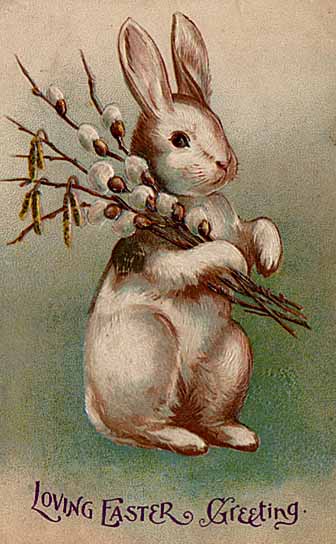
File:Easter Bunny Postcard 1907.jpg

File:Hase mit Ostereiern (2).jpg

File:Chocolate-Easter-Bunny.jpg


JUST PUSH PLAY


This next image is a 'Jack-a-Lope' at the Jackalope Restaurant in Austin, Texas:


http://www.njflyfishing.com/vBulletin/f5-north-eastern-general-discussion-forum/t22844-jack-lope-austin-texas.html

These photos are from the internet link below last photo:
(These were out when I was a kid!)

http://www.ebay.com/itm/2-Texas-TX-Cowboy-Exaggerations-JACK-LOPE-Vtg-/350373142642


http://www.chuckstoyland.com/potpourri/jackalope%20postcards/


The next photo is a real Texas Jack Rabbit:
http://www.tpwd.state.tx.us/huntwild/wild/species/rabbit/
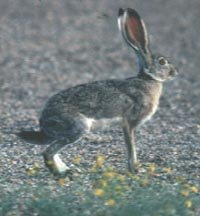
Photograph of the Black-tailed Jackrabbit
JUST PUSH PLAY TO SEE JACKRABBIT


The next article is on the Eastern Cottontail Rabbit:
http://www.rainbowwildlife.com/baby-rabbit.htm

Rabbit or Hare?

The most common rabbit species in Texas is the Eastern cottontail. It can be identified by its 2-3 lbs body, brown or gray coat, white belly, and distinctive white tail. They are common in brushy areas from southern Canada to South America.
Cottontails are an important part of the food chain, preyed on by more species than almost any other animal. Their amazing fertility is Mother Nature’s way of compensating to ensure their survival as a species.
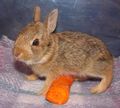
Orphaned Cottontail RabbitsCottontails feed in the evenings or at night. Their diet consists of a variety of green plants, barks, buds, and grasses.
Unlike the jackrabbit, which is actually a member of the hare family, cottontails are true rabbits.
This distinction is important, as hares are born virtually self-sufficient meaning they have their eyes open, body fully furred, and they have the ability to hop around only moments after birth, whereas rabbits are born hairless, blind, and helpless.
In addition, hares tend to be larger and more muscular than rabbits. It's hard to distinguish which is which when looking at live animals. However, try searching for their pictures using your home broadband connection-equipped computers and you will be able to tell the difference when you closely compare these images.
The eastern cottontail's nest is a saucer-like depression three or four inches deep and about eight inches across. It is lined with mouthfuls of soft, dead grass mixed with hair from the mother's breast. A covering of grass and hair is used to hide the nest and keep the young warm and dry.
Rabbit mothers nurse their babies for approximately 5 minutes a day. The milk is very rich and the babies fill up to capacity within minutes. Mother rabbits do not sit on the babies to keep them warm as do some mammals and birds. They will be in the nest early in the morning and then again in the evening, which gives the impression that the babies have been abandoned.
http://en.wikipedia.org/wiki/Eastern_cottontail
JUST PUSH PLAY


 Your photostudy is of my Real Easter Bunny!  These were taken at Kates Cabin Bird Sanctuary in Texas, front yard. This is Mr. Whiskers, the cottontail rabbit who lives in the woods across the road. He will be here on Easter Sunday with Cardinals instead of Eggs!!!!


Happy Easter from Big Dad, the Cardinal


We have come to the end of the trail.  Here we find the 'prized' Easter Bunny:


I found the whole ceramic family at Easterland,whatever.


Now for the Grand Finale!
The winning entry for Easter Bunny 2012 is:


SPACE  BUNNY


HOPPY  EASTER


Back to my Garden and Gifts for You:


Goodnight Everybody, see you next time.
On my Hunt for the next Bonus Video for You, I discovered something better than the Golden Egg:  James Onohan.
Enjoy the Loving Feeling of the Easter Weekend. Love is with Us.


http://jamesonohan.webs.com/My%20Life%20Homepage.html


JUST PUSH PLAY
Thank You James


Bonus Image:

Astronomy Picture of the Day
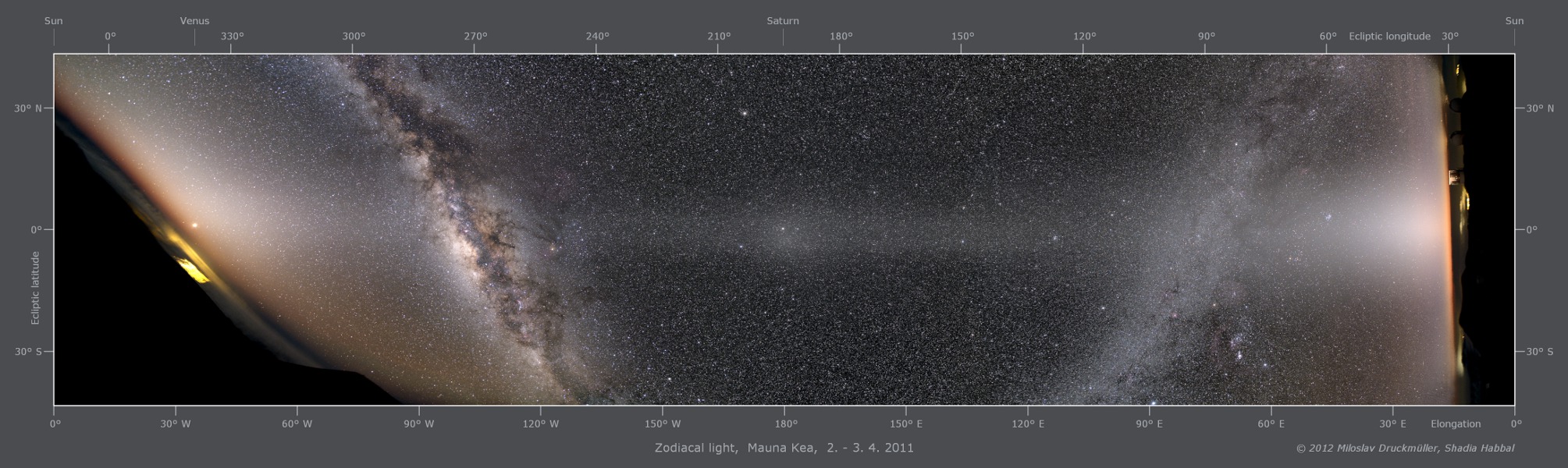

See Explanation.  Clicking on the picture will download
 the highest resolution version available.


Zodiacal Light Panorama 
Image Credit & Copyright: Miloslav Druckmüller (UM FSI, Brno Univ. of Technology), Shadia Habbal (IfA, Univ. of Hawaii)
Explanation: Sweeping from the eastern to western horizon, this 360 degree panorama follows the band of zodiacal light along the solar system's ecliptic plane. Dust scattering sunlight produces the faint zodiacal glow that spans this fundamental coordinate plane of the celestial sphere, corresponding to the apparent yearly path of the Sun through the sky and the plane of Earth's orbit. The fascinating panorama is a mosaic of images taken from dusk to dawn over the course of a single night at two different locations on Mauna Kea. The lights of Hilo, Hawaii are on the eastern (left) horizon, with the Subaru and twin Keck telescope structures near the western horizon. On that well chosen moonless night, Venus was shining as the morning star just above the eastern horizon, and Saturn was close to opposition. In fact, Saturn is seen immersed in a brightening of the zodiacal band known as the gegenschein. The gegenschein also lies near 180 degrees in elongation or angular distance from the Sun along the ecliptic. In the mosaic projection, the plane of our Milky Way Galaxy runs at an angle, crossing the horizontal band of zodiacal light above the two horizons. Nebulae, stars, and dust clouds of the bulging galactic center are rising in the east.


......this is brendasue signing off from Rainbow Creek


o+o

Thursday, February 23, 2012

Where Do Birds Sleep? (A Birding Photo Blog)


Hi Everybody!  Please come in for a small discussion. I can promise you there will be no Political Chats or Google+Cats!
Tonight we will be considering a complex question:  Where do Birds sleep? 
I know some of You are college educated Professionals who know the answers to many questions. So if you know the answer(s), please leave some comments about what You know. Some might say (logically) birds fly in the sky and sleep in the trees.  That would be partially right, but overall, an incorrect answer!


I will open the discussion with what I believe may be a correct answer. There is large variety of birds with different habitats and habits. All birds have a daily rest/sleep pattern that occurs in many different locations and at different times, but generally birds sleep close to the same area where they spend the waking period.


Tonight we are heading down to the end of Rainbow Creek to look at some birds and ponder the sleep situations. Just to remind you, Yes, I built a bird sanctuary, and Yes birds come, and Yes, I watch and feed them. This does not make me an expert on anything, especially birds. I have more questions than I have learned answers! I invite you to comment any experiences, ideas or whatever any time you want to, so all of us may learn from each other through personal stories. It may take awhile for this to happen as we are all very new in the Social Medium World. I look forward to impromptu  discussions as they may occur!


Here we are at Rainbow Creek in the Golden Hour of Sunset light.
I first thought about the big birds: The Ostrich and Emu. These birds are not local in South Texas, however, a few keep these birds on ranches, so I have seen them. They do not fly in the sky or sleep in trees. They go in the barn to sleep, is my first hand experience with the big birds. They do have the largest bird eggs. As a retired chef, I do know that one ostrich egg, scrambled, feeds 10 people.


In the sunset silhouette of the tree line, we do see a large bird on top of a Tree. It has been my observation here in Texas, that 'most' birds go to the location of the overnight roost during the sunset hour. Likewise, most leave the roost during the sunrise hour-everyday. They do not deviate from the pattern of their group.


Good Evening!  I see that you are a Great White Egret on Top of a tree at Sunset.


http://www.allaboutbirds.org/guide/Great_Egret/lifehistory/ac


Birds spend most of their time looking around for anything coming to get them for dinner.  For this reason, birds do not experience a 'deep sleep' like humans. Rather they have shorter resting periods to allow for immediate flight upon fright. These birds select treetops as most of their predators can not reach them.


Trees also provide a great lookout point over the water. Birds have very good eyesight and can detect slightest movement.


In addition to natural predators, some birds are hunted by humans.
Most humans that hunt birds, do so for food and take only what is necessary. Some humans shoot birds for fun or sport or because they move or fill in the blank:  whatever the reason, is wrong. It is not fun to kill birds and that should be taught to every human as a child.
The Great White Heron was hunted to near extinction by humans. They wanted the feathers for Hats.  (see link below for more info) 
 http://trueportraits.blogspot.com/2011/04/great-white-egrets-in-everglades.html


We see that our bird has chosen this treetop for his overnight roost. We see he does not land and go to sleep. He lands and looks around in all directions!


The water birds especially, seem to watch the others come in for the night and the sunset.
I could find no information as to whether birds dream. They do not eat in the trees (that I have ever seen) The eat during the day. (Exceptions of course, like the owls, who eat at night and sleep during the day)!


Here our bird stretches tall.  I found that perch birds have feet that grip the branch tightly.  When they bend the knee as they squat down on perch, the tendons pull tight on the talons to 'lock' the feet in place. This keeps the bird from falling off the perch during sleep! They need to stand up tall in the morning to 'unlock' the grip to fly.


Sunset!  Here they come!


These cattle egrets perch roost in treetops also. They crowd each other, but I have never witnessed one wreck!


The water birds gather in great colonies. Many fly in together from where ever they were during the day.


Some birds travel alone, but meet here at sunset like this wood stork


Here is a lone roseate spoonbill


A Great White Egret


This Wood Stork also stays on treetop roost!


 Hundreds of Birds in treetops here! (Circled is the Wood Stork)


These assorted Herons and Egrets meet in the water before flying up to the treetops.


This is their "Social Media Hangout"!!  Happy Hour!!


Hello from Rainbow Creek!


Some Birds, like Woodpeckers, sleep in cavities in Trees


This Downey Woodpecker shapes the hole to the perfect size!


Hello Everybody from Woody at Kates Cabin Bird Sanctuary in Texas!!


My Texas Buzzards  meet in a tree at sunset for a Social Media Hangout!! At dark, they fly up to the Tall Pine Trees on Rainbow Creek to Roost.


At Sunrise, they fly from the Pines back to the Meeting Tree.


When the sun rises to a certain height, they spread their wings to warm up!


At Sunset, the Buzzards return to the meeting tree. Hello Everybody!!


Thank You so much for coming by tonight! The discussion is officially open on the Question:  Where Do Birds Sleep?  Tonight we have looked at some Birds that roost in trees. Please join the discussion by putting any thoughts, comments or ideas you may want to share about sleeping birds!!


Bonus Video!!!!  Another great vid (no, not one of mine!)


This is again from our friend Yoshio, in Japan!
As I can only imagine a winter wonderland, this video is what I would imagine. The last kiss of winter 2012.  Enjoy!


.......this is brendasue signing off from Rainbow Creek. 
Happy Birding!


O+O